

Our current issue

UA: Ukraine Analytica
Issue 3 (38), 2025
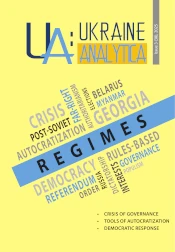
Regimes
- CRISIS OF GOVERNANCE
- TOOLS OF AUTOCRATIZATION
- DEMOCRATIC RESPONSE
Download Full Issue: 
 In pdf format
UA: Ukraine Analytica is the first Ukrainian academic and analytical journal in English language on International Relations, Politics and Economics. The journal is aimed for experts, diplomats, academics, students interested in the international relations and foreign policy. And our journal is published by the NGO “Promotion of Intercultural Cooperation” (Ukraine), Centre of International Studies (Ukraine), with the financial support of the Representation of the Friedrich Ebert Foundation in Ukraine.

0
THE TRAITS, PITFALLS AND LIMITS OF AUTOCRACY IN MYANMAR
Why do autocratic regimes appear so resilient, sometimes even expanding their influence, and yet remain so brittle when confronted with internal or external shocks? What explains their rise and where are the limits of their power? These questions will be addressed, using the experience of Myanmar, where recent developments provide a striking case of the...
0
SECURITY VERSUS PROSPERITY: THE FALSE DILEMMA ERODING GEORGIA’S DEMOCRATIC RESILIENCE
Once regarded as a frontrunner of the Eastern Partnership, Georgia is today sliding into authoritarianism, despite immense public support for European integration. This article explores the paradox of a pro-European society tolerating this democratic backsliding. It argues that a combination of internal and external factors has reshaped public priorities from democracy building to security. Russian...
0
NAVIGATING IN-BETWEEN GREAT POWER RIVALRY: HOW CAN UKRAINE SURVIVE AND THRIVE IN THE NEW GLOBAL ORDER?
The global order, as we have known it since the aftermath of World War II, is coming to an end. Trump’s second term as US President and his ‘America First’ policy; the emboldenment of revisionist powers such as China, Russia, Iran, and to a certain extent India,ly increasingly willing to challenge the US hegemonic role...
0
THE FUTURE OF UKRAINE IN THE ERA OF RISING GLOBAL POWERS: STRATEGIES FOR SURVIVAL AND SUCCESS
As new global powers emerge and traditional powers recalibrate, Ukraine’s position on the world stage is increasingly complex. How are the shifting global power structures influencing Ukraine’s strategic options? What role can Ukraine play in the evolving global order, and how can it leverage its strengths to safeguard its sovereignty and economic development? This paper...
0
THE NEW FACE OF DECEPTION: AI’S ROLE IN THE KREMLIN’S INFORMATION WARFARE
The rapid evolution of artificial intelligence (AI) has empowered new dimensions of global information warfare. AI-driven technologies, such as deepfakes and sophisticated bot networks, have become pivotal tools of disinformation campaigns carried out by authoritarian regimes. This article highlights the information security threats posed by AI-driven technologies. The authors examine Russia’s approach to using AI...
0
NODAL DEFENCE AND UKRAINE’S NATO ASPIRATIONS
This article describes how Ukraine is applying for NATO membership at a time when the European security architecture is becoming more fragmented. Specifically, as much as NATO continues to provide a coherent, multilateral framework that organises European security relations, various bilateral and ‘minilateral’ security formats have proliferated across the continent, while different members of this...
0
PERFECT STORM FOR UKRAINIAN FOREIGN STRATEGY
Even though the full-scale invasion of Russia in 2022 has changed the global and European geopolitical landscape, there have already been signs of so-called ‘war fatigue’ or getting back to business as usual. However, Ukraine’s perception of the world and its role within it has irrevocably changed. This article explores the transformation of Ukraine’s role...
0